
Summers here are long, hot and wet, the water table is high, and the air outside is often close to saturated. A house that stays damp for a few days in July can grow visible mold before the weekend is over. Removal is the work of taking that growth out of the building and, just as important, taking away the reason it grew. Here is how a proper job runs, what it covers, what you can handle yourself and what to ask before anyone starts cutting.
If you are not sure what you have, start with mold inspection and testing. If the cause is a recent leak or storm water, drying comes first, and that is covered under water damage restoration.
Removal, remediation and cleanup mean the same job
You will hear all three words. In practice they describe one process: find the moisture, contain the area, take out materials that are too far gone, clean what can be saved, dry everything and confirm the result. The labels differ from company to company, so compare what is actually in the written scope rather than the name on the quote.
When you may not need a company
The EPA's guidance for homes is that a small area of mold, roughly 10 square feet or less, on a hard surface is often something a homeowner can handle. That is about a three by three foot patch. Tile, glazed surfaces, sealed wood trim and metal can usually be scrubbed with detergent and water, then dried completely.
A few conditions change that answer:
- The growth sits on drywall, ceiling tile, carpet or insulation. Porous materials usually have to be removed, not cleaned.
- The patch keeps coming back after you clean it. That means water is still arriving.
- The area is larger than a few square feet, or you find it behind a wall, under flooring or in a duct.
- Someone in the home has a health concern that makes exposure risky. Ask a doctor about that, and keep the person out of the work area.
- The cause was sewage or floodwater. That is a different category, covered under sewage cleanup and flood damage restoration.
If you do the small job yourself, wear an N95 or better respirator, gloves and eye protection, keep the area closed off from the rest of the house, and fix the moisture before you clean anything.
The sequence of a proper job
1. Find and stop the water. Mold removal without a moisture fix is a temporary result. In this region the source is often one of a short list: an air conditioner condensate line that clogged and overflowed, a drain pan in an attic air handler, a plumbing leak in a slab or under a raised floor, wind-driven rain through a window or stucco crack, a roof leak after a storm, or humid air moving through an open crawl space. A good crew asks about the history of the house and checks these places before talking about cleanup.
2. Document the damage. Photos, moisture readings and a written description of what is affected help with any insurance conversation and give you something to compare against when the job is done.
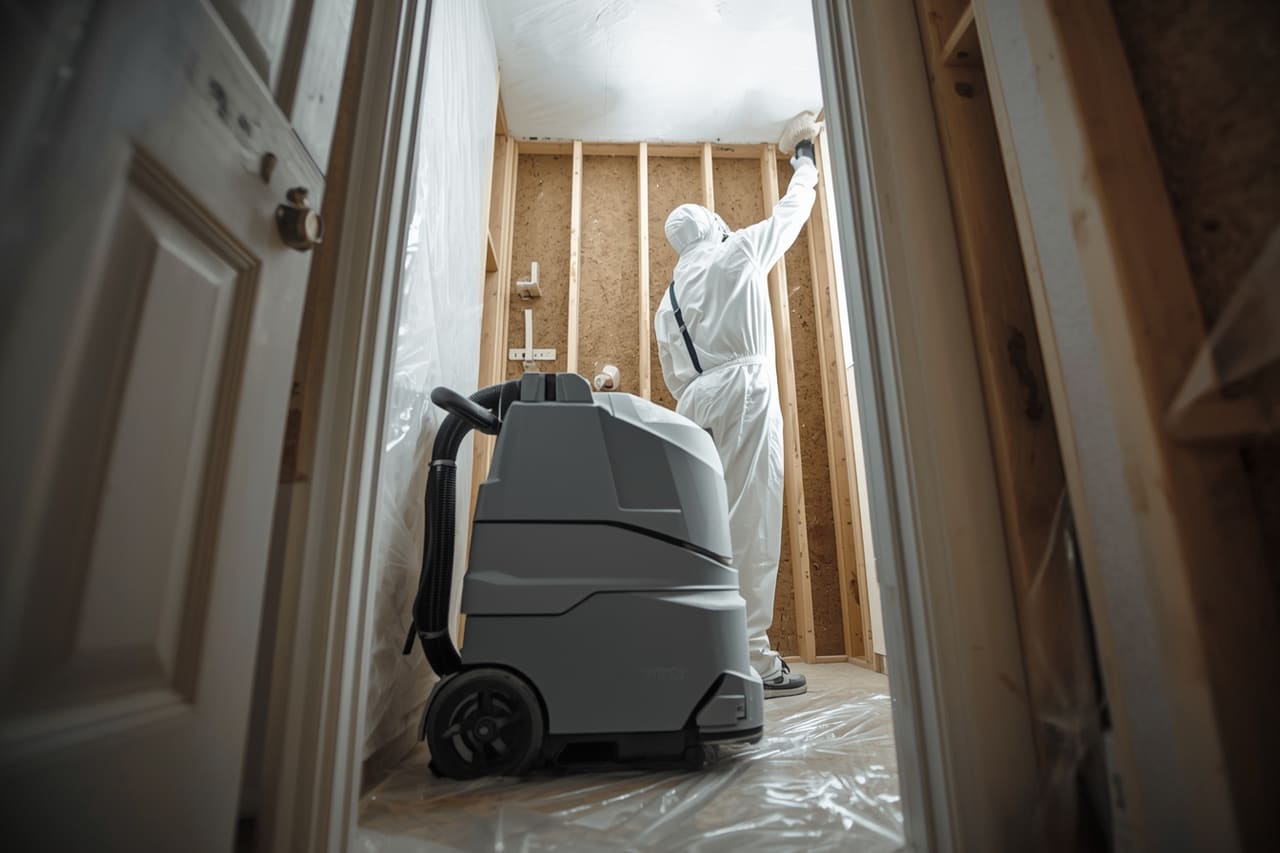
3. Contain the area. Plastic sheeting taped at the edges and zipper doors keep the work separate from the rest of the house. A fan exhausts air from the work area outdoors, so the room is under slight negative pressure and spores are pulled out instead of drifting into hallways. In a house with a central system, the supply and return in the work area get sealed, because moving air carries spores everywhere.
4. Remove what cannot be saved. Wet or moldy drywall, insulation, carpet and pad, and ceiling tile are bagged and taken out, usually cutting a bit beyond the visible edge. Cuts are made in a way that limits dust, and debris is bagged inside the containment before it moves through the house.
5. Clean what can be saved. Framing, subfloor and other structural wood are usually cleaned rather than replaced. Methods include HEPA vacuuming, damp wiping and, for stubborn growth on wood, light sanding or wire brushing in a controlled setup. The goal is to remove the growth, not just change its color.
6. Dry everything. Fans and dehumidifiers bring materials back to a normal moisture level. The EPA advice is to dry wet materials within 24 to 48 hours of a water event, and the same principle applies after removal: nothing gets closed back up until it reads dry.
7. Verify and rebuild. A final inspection confirms no visible growth and no remaining moisture. Then repairs start. Rebuild work is a separate step, and it matters that it waits for the dry reading.
What stays and what goes
Porous materials that absorbed water and grew mold are generally removed. Hard, nonporous materials are generally cleaned. The middle group depends on the situation.
- Drywall and plaster. Drywall with growth is cut out. In older Savannah and Beaufort houses, plaster over lath is harder; it is sometimes saved when growth is only on the surface and the wall can dry, but moisture inside the wall decides it.
- Insulation. Fiberglass batts that got wet are removed. Wet insulation under a raised floor often hangs down from the subfloor and holds water against the wood, so it comes out first.
- Subfloor and framing. Usually cleaned and dried. Boards that are soft, crumbling or rotted get replaced. Soft wood near a leak is also a reason to call a pest professional, because moisture draws termites and other wood-destroying insects.
- Carpet and pad. Removed once mold is established.
- Hardwood and heart pine. Old heart pine floors can often be saved with slow, controlled drying, but cupped boards with growth underneath may need to come up.
- Ductwork. Metal duct can be cleaned. Flexible duct and duct board that grew mold are usually replaced. Ducts that sweat in a hot attic or under a house are a common starting point; see the crawl space page below.
- Furniture and belongings. Hard items are cleaned. Soft items with established mold are often discarded. Valuable or sentimental pieces may be worth a specialist; see contents pack-out.
Black mold, in this context
Color does not tell you what kind of mold you have. Many species look black, and many dangerous-sounding ones look green or white. The CDC does not recommend identifying the species in a home as the basis for cleanup decisions. Visible mold gets removed and the moisture gets fixed, whatever the color. If someone in the home is having symptoms, that is a question for a doctor.
Shortcuts that usually fail
- Bleach. The EPA does not routinely recommend bleach for mold. It can lighten a stain without solving anything: the moisture is still there, and growth inside drywall or wood is still there. Porous material with growth usually comes out.
- Fog and spray treatments over the top. A coating or a fogger does not remove growth or fix a wet wall. If it covers the problem, the problem is still there.
- Painting over it. Paint hides a stain for a few weeks. Mold under it keeps growing and shows through.
- Running a dehumidifier in a house with an open leak. It helps with the air, but the wet material stays wet.
- Opening windows in August. Outdoor air in the Lowcountry is often wetter than the air inside, so ventilating can raise indoor humidity instead of lowering it.
Crawl spaces and raised homes
A large share of homes here sit on crawl spaces or raised foundations. Mold under a house is common, usually tied to humid air coming through vents, a vapor barrier that tore or is missing, sweating ducts and wet insulation hanging from the floor above. It deserves its own treatment, because the fix involves the whole space and not just the surface. See crawl space mold removal and the longer guide on crawl space mold in Lowcountry homes.
Older homes: check before disturbing materials
Houses built before 1978 may have lead paint, and older materials such as some flooring, plaster, pipe wrap and ceiling texture may contain asbestos. Sanding, cutting or demolishing them can release particles. Before demolition in an older home, ask the crew how they handle lead and asbestos, and ask whether a test of the material is called for. In historic downtown Savannah and Beaufort, that applies to a lot of buildings. The EPA's lead and asbestos pages explain the basics: epa.gov.
Who does mold work in Georgia and South Carolina
Neither state licenses mold inspectors or mold remediation companies today. South Carolina has a bill, H.5109, introduced in February 2026, that would create certification for mold assessors and remediators and would stop an assessor from doing remediation on a structure they assessed in the previous 12 months. It is in committee and is not law.
That means there is no state license to ask about for the mold work itself, and anyone who claims to hold one deserves a follow-up question. What you can ask for:
- Industry training credentials you can verify with the organization that issued them.
- A written scope, price and contract before work starts.
- Proof of liability insurance, which you can confirm with the insurer.
- References from recent jobs similar to yours.
- For repair and rebuild work, the contractor's state license number. Georgia and South Carolina both license general and residential contractors, and larger repair jobs generally require that license. The Georgia State Licensing Board for Residential and General Contractors and the South Carolina Department of Labor, Licensing and Regulation both let you look a license up.
What a good quote contains
- The affected rooms or areas, with a sketch or photos.
- The moisture source and who is fixing it. If the crew is not fixing it, the quote should say so.
- The containment method and the air handling.
- What gets removed, what gets cleaned and how.
- How waste is handled.
- The drying equipment and the target reading.
- How the work will be checked afterward and by whom.
- What is excluded, such as rebuild, painting and flooring.
- The price, as a number or a clear unit price, and what happens if the crew finds more once walls are open.
Be cautious about a quote that fits on a business card, a price that arrives before anyone looked at the house, or a company that pushes for a signature the same hour.
Who checks the work
On a small job, a final visual check and a moisture reading may be enough. On a larger one, the cleanest arrangement is a check by someone other than the crew that did the removal, since a company grading its own work has an obvious conflict. That check can include visual inspection, moisture readings and sometimes air or surface sampling compared against outdoor air. The mold inspection page covers how to read such results.
What it costs, in general terms
Cost depends on the size of the area, the materials involved, how hard the space is to work in and how much has to be rebuilt afterward. A small contained area can run a few hundred to a couple of thousand dollars. A whole room or a crawl space often runs into the thousands. A house-wide job with HVAC involvement can reach well into five figures. A written quote after an in-person look is the only number worth relying on, and the quote should separate removal from rebuild.
Insurance and mold
Homeowners policies often cover mold only when it results from a covered event, such as a sudden pipe break, and often cap or exclude it otherwise. Flood damage is generally excluded from homeowners coverage and handled through a separate flood policy. Read your policy or ask your agent before work starts, take photos before anything is thrown out, and keep receipts. Do not assume a conversation with an adjuster is a commitment.
Where to go next
Not sure whether it is mold at all? See mold inspection. Wet from a storm or leak? See storm damage restoration or burst pipe water damage. Planning repairs afterward? See repairs after water damage. A second home left closed up all summer is a special case, covered in closed-up homes and rentals.