
Frozen pipes are rare on the coast, but pipes still fail here: old galvanized and copper lines corrode, plastic fittings crack, washing machine hoses burst, water heater connections let go and slab leaks start where a line rubs the concrete. A hard freeze does happen now and then, and when it does, homes that were never built for it are hit. Whatever the cause, the damage pattern is the same: fast water, hidden spread and a short window before mold.
The first ten minutes
- Shut off the water. Know where the main shutoff is, usually at the meter, near the street, or where the line enters the house. For a single fixture, use the valve under the sink or behind the toilet or washer.
- Turn off the water heater if the leak is near it, and shut off power to the affected area at the breaker if you can reach the panel without standing in water.
- Open a faucet low in the house to drain remaining pressure in the line.
- Move belongings off wet floors, and lift furniture legs off wet carpet.
- Take photos and video before you start cleanup.
- Call your insurer and a plumber. Many insurers want a plumber's repair invoice as part of the claim.
If you cannot find the shutoff or it will not close, call a plumber first. A water utility can also shut off service at the meter.
Where the water goes
Water does not stay where the pipe broke. It runs along the floor, soaks into drywall by wicking up from the bottom, travels down through ceilings and into wall cavities, and ends up under flooring and cabinets. In a two-story home, a leak upstairs soaks the ceiling below and runs down inside the walls. The wet area you see is usually smaller than the wet area that exists.
Moisture meters and thermal cameras help locate it, and a good crew maps it before deciding what to remove.
Drying a burst pipe loss
The process is covered in water damage restoration. In summary: extract standing water, remove materials that cannot be dried, set air movers and dehumidifiers, and monitor until readings return to normal. Clean supply water is the easiest category, but it does not stay clean. The EPA advises drying wet materials within 24 to 48 hours to prevent mold.
Common Lowcountry leak sources
Slab leaks. Many newer homes in subdivisions around Pooler, Bluffton and Hardeeville sit on concrete slabs, and supply lines can run through or under them. Clues include a warm spot on the floor, the sound of running water with everything off, a water bill that jumped and a meter that spins with every fixture closed. Slab leaks are often found only after flooring is damp. A plumber with leak detection equipment locates the line, and the repair can mean opening the floor or rerouting the pipe through the attic or walls.
Water heaters in garages and closets. A tank fails at the bottom or at a fitting and runs for a long time before anyone notices. If the heater sits in a closet, the water goes into the carpet and the wall.
AC condensate lines and drain pans. These overflow in summer, when the system runs hard. The result looks like a plumbing leak, and the fix is a cleared line, a new pan or a float switch that shuts the system off when the pan fills. See the section below on ceilings.
Washing machine hoses and ice maker lines. Rubber hoses age and burst, and the damage is often found on return from a trip. Braided steel hoses and a shutoff valve you actually close when leaving reduce the risk.
Older galvanized and polybutylene lines. In houses with older plumbing, corrosion or brittle fittings can fail. Repiping decisions are for a plumber and your insurer.
Under a raised house. Lines and drains under a crawl space can drip for a long time. The water softens subfloor and insulation, and mold follows. See crawl space mold removal.
Hidden leaks and slow ones
Not every leak is a burst. A slow drip behind a wall, under a sink or under the house can run for months. Signs include stains on ceilings or walls, bubbling paint, warped baseboards, a musty smell, mold on drywall and an unexplained rise in the water bill. A mold inspection can find where the moisture is. Insurers often treat long-term seepage differently from a sudden break, so photograph what you see and tell your agent when you discover it.
Ceilings that bulge
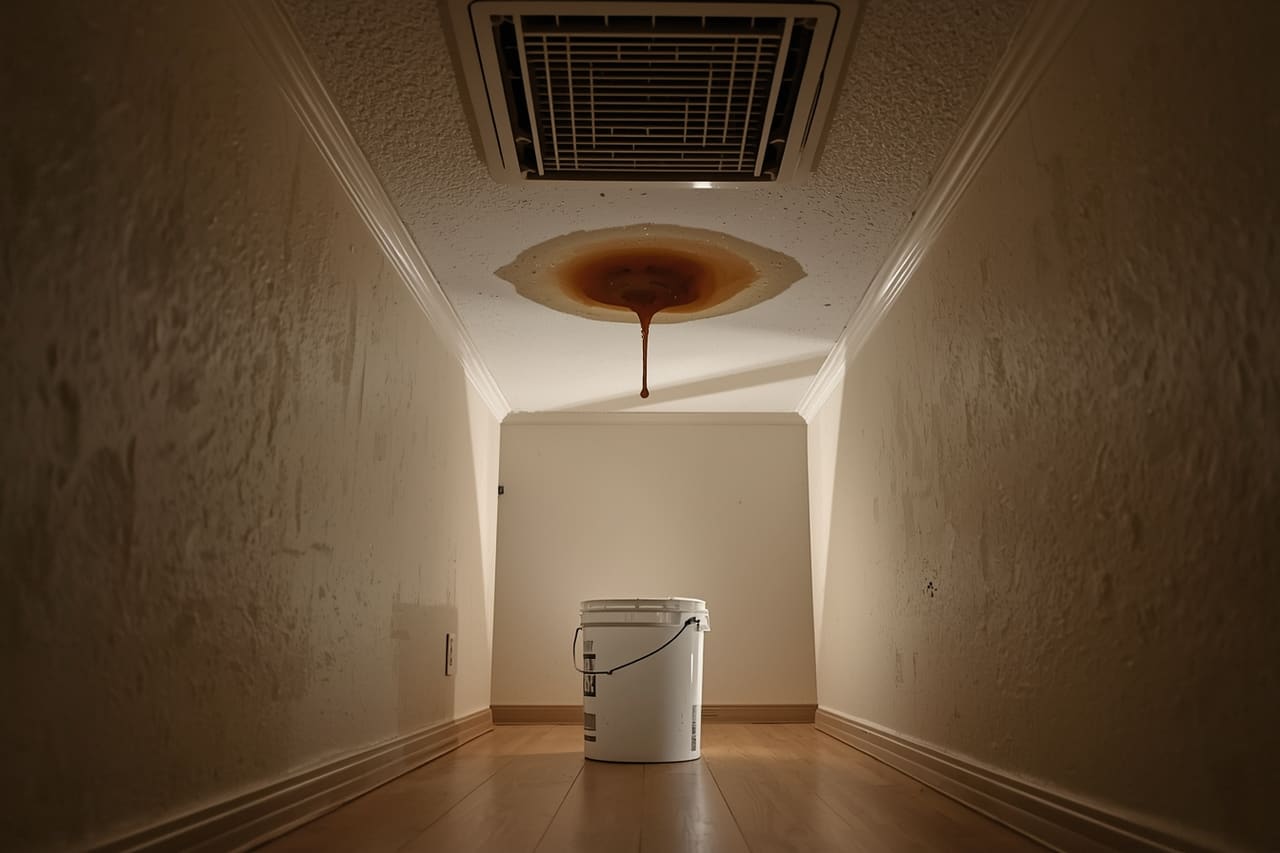
If water pools on the back of a ceiling, it bulges and may drop suddenly. Keep everyone out from under it, shut off power to that area at the breaker only if you can reach the panel without standing in water, put a bucket under the drip and call. Do not push on it or open it yourself. The ceiling will usually need to be removed and replaced.
Mold risk
Water that sits in drywall, insulation or carpet for more than a day or two can grow mold, especially in warm, humid weather. If you notice a smell or spots after a leak, treat it as a mold job: see mold removal. If the leak was in a vacation rental or second home that sat closed, damage can be advanced by the time it is found; the guide on closed-up homes and rentals explains what to check.
Insurance
Homeowners policies commonly cover sudden and accidental water damage from burst pipes and appliance failures, and often exclude slow leaks, long-term seepage and flooding. Policies differ in what they say about the cost of finding and fixing the pipe itself versus the damage it caused. Read your policy or ask your agent. Keep the broken part if you can, since the adjuster may want to see it, and keep plumber and drying invoices.
What to ask a crew
- What is in the written scope, and does it include monitoring visits and equipment?
- How will you show me that the materials are dry before anything is closed up?
- What happens if more water damage appears behind the wall?
- Who handles rebuild, and can I see that contractor's state license number? Georgia and South Carolina both license general and residential contractors, and the license can be checked with the Georgia State Licensing Board for Residential and General Contractors or the South Carolina Department of Labor, Licensing and Regulation.
- For plumbing, ask for the plumber's license number too, and confirm proof of liability insurance.
Where to go next
See water damage restoration for the full drying process, repairs after water damage for rebuilding, and contents pack-out for wet belongings.