
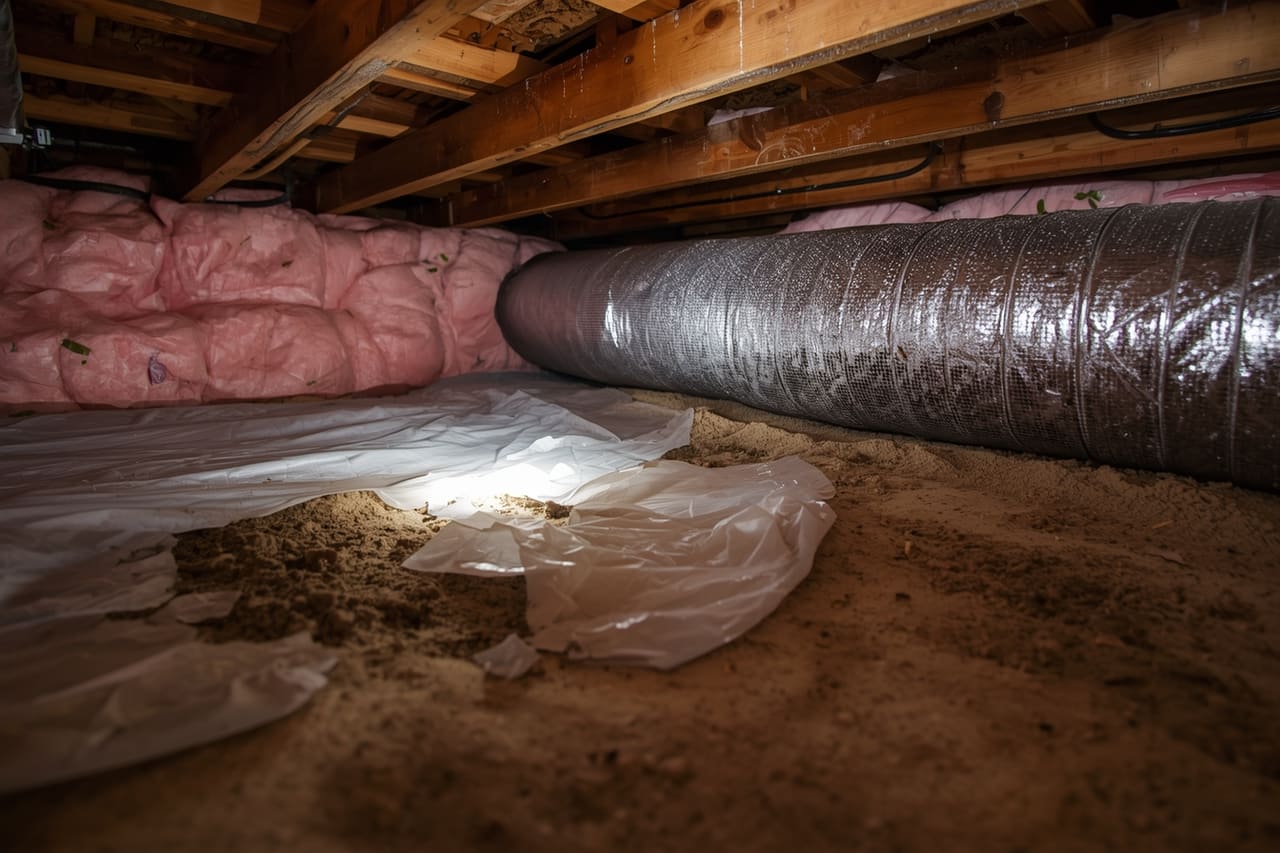
Few places in the Lowcountry grow mold as reliably as the space under a house. The ground is close to the water table, summers run hot and wet, and the traditional answer, vents in the foundation wall, brings that humid air straight in. When the outside air meets cooler wood, ducts and soil, moisture condenses and stays. Over a season or two, floor joists, subfloor and insulation can go from damp to visibly moldy without anyone noticing, because nobody goes under there. Here is how crawl space mold develops, what removal involves, what keeps it from coming back, and when it is more than a mold problem.
For the longer explanation of why raised homes behave this way, see the guide on crawl space mold in Lowcountry homes.
Why crawl spaces grow mold here
Humid air through open vents. Foundation vents were meant to let a crawl space dry out. In a climate where summer outdoor air is often wetter than the air under the house, they do the opposite. Warm, moisture-laden air comes in, touches cooler surfaces and drops its water on them.
A vapor barrier that failed. A plastic sheet over the soil slows ground moisture from rising into the space. Sheeting gets torn by a plumber, pushed aside by an animal, rotted by time or was never installed. Bare soil under a house gives off a surprising amount of water every day.
Sweating ducts and air handlers. Cold air moving through ductwork in a hot, humid space makes the outside of the duct drip, much like a glass of iced tea. Air handlers installed under the house add to it. Duct insulation that is wet, torn or fallen off makes it worse.
Wet insulation hanging from the subfloor. Fiberglass batts held up by wire or netting soak up moisture, sag and hold water against the wood above. The insulation then keeps the subfloor damp for weeks.
Plumbing and drain leaks. A small supply leak, a slow drain, a leaking water heater overflow or an AC condensate line that terminates under the house can wet one area all year.
Rain, tide and grading. Water pooling beside the foundation, downspouts that empty near the wall and, in low areas and on the islands, high tides and storm surge that push water under a house all add moisture. Flooding is its own category; see flood damage restoration.
Signs you have a problem
You do not have to crawl under the house to suspect something.
- A musty smell inside that is strongest near floor vents, closets on exterior walls or the first floor
- Floors that feel soft, cup, buckle or bounce in one spot
- Doors and windows that stick in summer
- Rooms that stay humid even when the AC runs
- Higher energy bills with no change in habits
- Visible condensation or dripping from ducts when you look through the access panel
- Insects, such as termites or wood-destroying beetles, near wet wood. That is a question for a pest professional, who should look at it separately from the mold work.
What a crawl space inspection covers
Whoever goes under the house should bring a flashlight, moisture meter, camera and protective gear, and should come back out with photos and a written summary. They look at:
- The condition and coverage of the vapor barrier
- Soil: bare, damp, standing water, signs of past water lines on the piers
- Insulation: wet, fallen, moldy
- The subfloor and joists: moisture readings, staining, soft spots, fuzzy growth
- Ducts and air handlers: sweating, torn wrap, disconnected runs
- Plumbing: drips, stains, corrosion
- Vents and openings: how many, where, and whether anything blocks or opens them
- Wood condition: rot, termite damage or tunnels, which belong with a pest professional
The mold inspection page covers when sampling is worth it. For a crawl space with visible growth, it usually is not.
What removal and drying involve
1. Fix or isolate the water sources. A leaking line gets repaired. A drain gets redirected. Gutters get extended. Without this step, everything after it is temporary.
2. Remove wet or moldy insulation and debris. Batts that sagged and soaked are bagged and removed. Loose trash, old cardboard, stored items and rotted wood scraps come out too.
3. Contain and control the air. Plastic barriers and negative air keep spores from drifting up through gaps into the living space. Floor penetrations for plumbing and ducts are common pathways, so the house air handler is usually turned off while the work is under way.
4. Clean the wood. Joists, subfloor and sills with surface growth are cleaned with HEPA vacuuming and mechanical methods such as brushing or controlled sanding, and in some cases with soda or dry ice blasting. Cleaning the wood means removing the growth, not covering it. Boards that are soft or rotted are replaced.
5. Dry the space. Industrial dehumidifiers and air movers bring wood moisture down to normal. A common target is wood in the range of the mid-teens percent moisture content or below, and a space that holds steady for a few days. The EPA advice to dry wet materials within 24 to 48 hours applies when the cause is a recent water event; chronic crawl space dampness takes longer.
6. Correct the conditions. This is the step that decides whether the mold comes back.
What keeps it from coming back
There is no single right answer for every house, and anyone who says there is should explain why.
Vapor barrier. A heavy plastic liner over the soil, lapped at the seams and run up the piers and walls, cuts ground moisture. It works best with the other steps and does not fix humid air coming in through the vents.
Sealing and conditioning the space. A sealed, or encapsulated, crawl space closes the foundation vents, lines the floor and walls and adds either a dehumidifier or a connection to the conditioned air of the house. This approach has become common for coastal homes because it stops the humid summer air at the door. It does cost more, needs maintenance, and has to be done carefully, especially around combustion appliances and a space with a plumbing leak or standing water.
Dehumidifier. A crawl space dehumidifier with a drain line or pump is often paired with a vapor barrier. It should have a humidity readout, and a drain that actually works.
Duct repair. Ducts need sealed joints and intact, dry insulation so they stop sweating.
Moisture and drainage. Gutters, downspout extensions, soil grading away from the house, and a way for water to leave the space matter more than any product.
Monitoring. A cheap humidity sensor under the house that you can check from your phone catches a bad week before it turns into a bad year. A reading that stays in the 50 to 60 percent range or below is a common goal for the space.
Be cautious about packages that sound complete. Closing vents without addressing a leak traps moisture. A liner laid over standing water or wet soil does nothing. And a spray treatment on top of mold is not removal.
DIY check or professional job
A homeowner who is comfortable in a tight space can do a safe first check: look through the access panel with a flashlight, check for standing water, torn plastic, dripping ducts and hanging insulation, and take photos. Do not go in with a sore back, in the middle of summer afternoon heat, or with a known snake or insect problem. Wear a respirator, gloves and eye protection, and let someone know you are under there.
Call a professional when you see widespread fuzzy growth on joists, soft wood, standing water, sagging insulation across much of the floor, a smell that has moved into the house, or any sign that moisture is coming from a plumbing leak you cannot find. Tight spaces, heat and mold are a poor combination for a do-it-yourself job.
Who does this work in Georgia and South Carolina
Neither state licenses mold inspectors or mold remediation companies today. South Carolina bill H.5109, introduced in February 2026, would create mold assessor and remediator certification and prevent an assessor from remediating a structure they assessed in the last 12 months. It is in committee and not law. Until then, ask for:
- Industry training credentials you can verify with the issuer
- A written scope and contract that lists the rooms, the work and what it will cost
- Proof of liability insurance
- For vapor barrier, plumbing, structural and repair work, the contractor's state license number, which you can check with the Georgia State Licensing Board for Residential and General Contractors or the South Carolina Department of Labor, Licensing and Regulation
- On a larger job, a final check by someone other than the crew that did the work
What it costs, in general terms
Costs depend on square footage, access, how much wood and insulation is affected and what the fix includes. Cleanup alone can be in the low thousands. Adding a new vapor barrier, insulation, vent sealing and a dehumidifier can push a job into the many thousands, and a full encapsulation of a large house can be higher still. Plumbing, duct and wood repairs are priced separately. Get a written, itemized quote after someone has been under the house, and ask which parts are cleanup, which are prevention and which are repair.
Insurance
Standard homeowners policies often cover mold only when it follows a covered sudden event, and they commonly exclude long-term seepage, humidity and flooding. Flood damage generally falls under a separate flood policy. Read your policy or ask your agent before work begins, photograph the space first, and keep written records.
Where to go next
If the crawl space is wet from a leak, water damage restoration covers drying. If rot or damaged wood needs replacing, see repairs after water damage. For the broader job of mold removal in the living space, see mold removal. Homes on the barrier islands and in low-lying neighborhoods may find Tybee Island and Hilton Head Island relevant, since raised and beach houses are common there.