
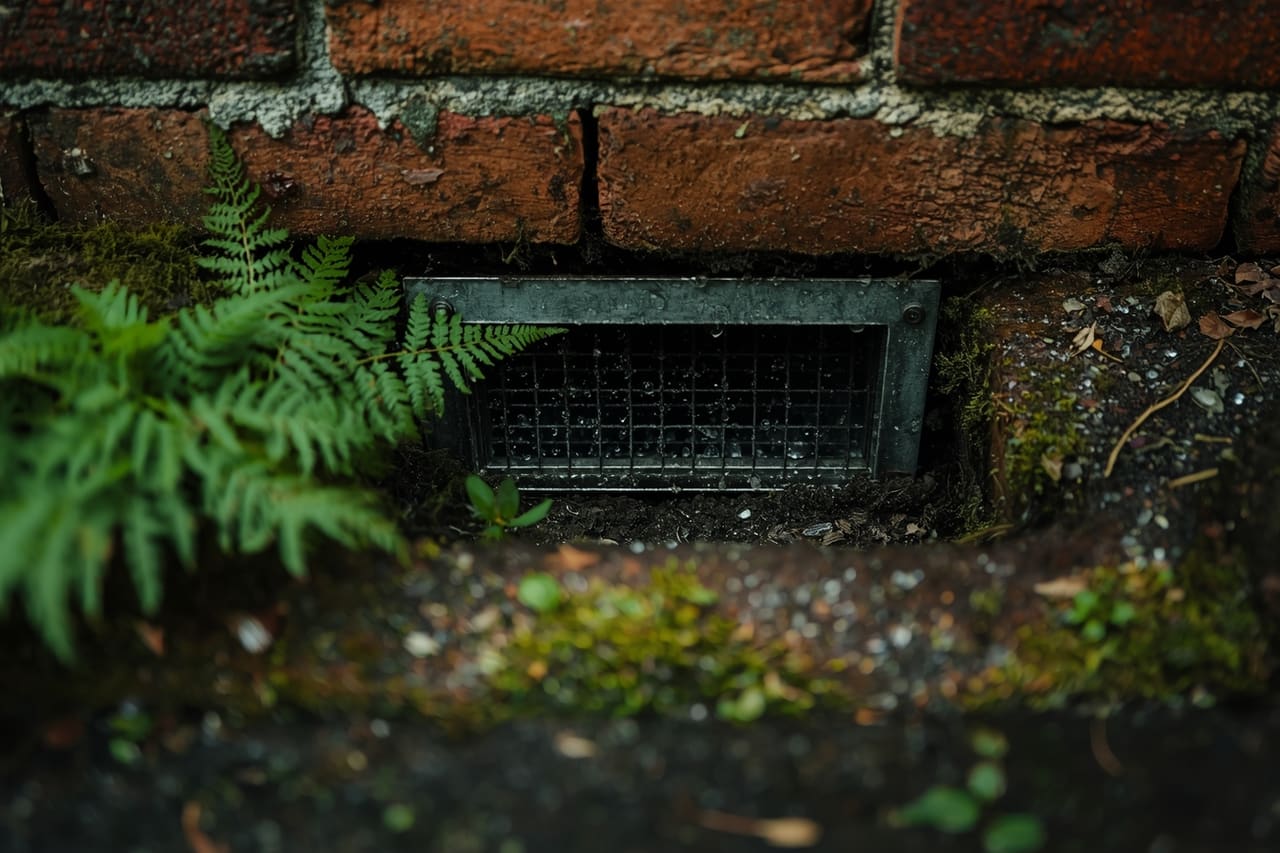
Raised houses are everywhere in this region, from beach cottages to brick ranches to older homes in town. Building up off the ground made sense for a wet, flat landscape with a high water table. The space underneath, though, sits in a climate where July air holds a great deal of water, and a crawl space is where that air meets cool surfaces. When the floor above is mold-free and the crawl space is not, the crawl space is usually the reason for any musty smell indoors. A related look at how raised houses fare in tidal areas is in the town page for Tybee Island.
Why the space under the house grows mold
Mold needs organic material, moisture and time. A crawl space supplies all three. Floor joists, subfloor sheathing and paper-faced insulation are food. Ground moisture rises from the soil even when the surface looks dry. Humid outdoor air enters through vents and meets cooler wood and ductwork, and the water in that air condenses on the cold surfaces. Add a leaky plumbing joint, an AC condensate line that empties under the house or a downspout that dumps beside the foundation, and the space stays damp for months.
Several things that are common here make it worse:
- A ground cover that has failed. A plastic sheet over the soil should block ground moisture. In many older crawl spaces it is torn, pushed to the side, or was never installed.
- Ducts under the floor. Cold supply ducts in a hot space sweat. The insulation around them can soak and sag.
- Wet insulation hanging from the subfloor. Fiberglass batts that have absorbed water hold it against the wood and fall away, leaving the joists exposed.
- Open vents in summer. Vents pull in warm, wet air exactly when it is least helpful.
- Poor drainage outside. Soil that slopes toward the house and gutters that discharge at the foundation send water straight in.
Vented and sealed crawl spaces in plain terms
The traditional design is a vented crawl space: openings in the foundation wall let air flow through, which was thought to carry moisture away. That works in dry climates. In a humid one, outdoor air carries more moisture than it removes during much of the year.
A sealed (or closed) crawl space takes the opposite approach. The vents are blocked, a heavy vapor barrier covers the ground and runs up the walls, any gaps are sealed, and the space is dried by a dehumidifier or conditioned by a small amount of air from the house. The goal is to keep outdoor humidity out and hold the space at a stable, drier level. Building and energy-code guidance in humid regions has moved toward this approach, but each house is different. Flood-prone sites need vents or openings designed to let flood water pass, so sealing is not simple everywhere. An engineer, a building official or a qualified contractor should confirm what is allowed on your lot before you close vents in a flood zone.
Whichever design you have, the same rules apply: keep liquid water out, keep the ground covered, control the humidity, and make sure the air handler, ducts and plumbing in the space are not adding moisture.
What a vapor barrier does
A vapor barrier is a thick plastic sheet laid over the soil. It blocks water vapor from rising into the space. A good installation overlaps seams, is sealed at the edges and runs up the walls and around piers. A thin sheet laid loosely does much less. Walking and crawling on it wears it out, and water that pools on top of the barrier after a leak or a storm stays there. If you can see bare soil, wet soil or a barrier that is shredded or full of puddles, the space is not protected.
Ducts, air handlers and the sweating problem
In many houses here the air handler sits in the crawl space or the ducts run beneath the floor. Cold air inside the duct and humid air outside create condensation anywhere the insulation is damaged or the seams leak. Droplets form on the duct, drip on the barrier or the soil and wet the floor above. Check that:
- Duct insulation is intact with no sagging or missing sections.
- Duct seams and joints are sealed and connected.
- The condensate line from the air handler drains outside, not into the crawl space.
- The air handler's drain pan is dry and not rusted through.
A clogged condensate line is one of the most common culprits for summer water in a crawl space or closet, and algae builds up quickly in warm weather.
Dehumidifiers and humidity targets
In a sealed crawl space, a dehumidifier built for the job runs continuously and drains outdoors or to a pump. A common target for indoor air is a relative humidity around 30 to 50 percent, which is the range the EPA mentions for homes. A sealed crawl space is often held a bit higher than that, but not so wet that wood stays damp. An inexpensive humidity monitor lets you see what is happening. If the reading sits above about 60 percent for long stretches in warm weather, mold has what it needs.
A consumer dehumidifier dropped in an open, vented space fights a losing battle because the air keeps coming in. Dehumidifying works best after the space is sealed and the ground is covered.
How to look yourself, and when not to
A check from the access panel is reasonable if you are comfortable and the space is safe. A few precautions:
- Turn off power to anything in the crawl space that you might touch, or have someone else do it.
- Look for standing water, a snake or insect nest, exposed wiring and anything that looks unsafe. If the soil is wet or there is water, do not go in.
- Wear coveralls, gloves, eye protection and an N95 respirator.
- Use a flashlight and a phone camera. Photograph the barrier, the insulation, the ducts, the joists and any dark or fuzzy growth.
- From the access, look for darkened, crumbly or soft-looking wood on the joists and subfloor near plumbing and walls. Wood like that may be rotted, which is beyond a mold issue.
Stop and call a professional if you find sagging subfloor, active leaks, large areas of growth, wet insulation across most of the space, sewage or a smell of rot. The same applies if you have a respiratory condition or a weakened immune system, in which case ask a doctor before doing any of this.
Mold, rot and termites are not the same thing
A crawl space with wet wood can host mold, wood-decay fungus and wood-destroying insects at the same time. Mold grows on the surface and can often be cleaned or removed. Decay fungus breaks down wood fibers and weakens joists. Termites eat wood and leave mud tubes or damaged grain. If you see tunnels, mud tubes, soft wood or insect droppings, call a pest professional. A restoration specialist can handle wet materials and mold, and a pest professional handles termites and similar pests. A structural problem, such as a sagging beam or floor, calls for a qualified contractor or engineer.
What professionals do
A typical crawl space job runs in this order, though the details vary:
- Fix the water source. Repair leaks, redirect the condensate line, extend downspouts and fix the grade.
- Remove wet and damaged materials. Wet insulation comes out and goes into bags. Moldy, soft or contaminated materials are removed.
- Clean the framing. Surface mold on solid wood is often cleaned with HEPA vacuuming and mechanical methods such as sanding or wire brushing, and sometimes with media blasting for larger areas.
- Dry the space. Fans and dehumidifiers run until moisture readings are normal.
- Install or repair the ground cover and, where appropriate, seal the space.
- Check the result. For a larger job, a check by someone other than the crew that did the work is the strongest way to confirm it.
See crawl space mold removal for more on the process, and mold removal for the general steps.
What it costs, in general terms
Prices vary widely with the size of the space, how deep the problem is, whether there is rot and how hard it is to get into. Cleaning and drying a modest area costs far less than removing all insulation, fixing structure, installing a heavy barrier and a dehumidifier and sealing the space. Ask for a written scope that lists each step, and get more than one estimate. Insurance rarely pays for a crawl space that has been damp for a long time; homeowners policies commonly cover sudden events such as a burst pipe and not slow seepage or humidity. Check your policy or ask your agent.
Prevention, season by season
- Spring: check the ground cover, the condensate line and the gutters before the humid season.
- Summer: watch the humidity reading, listen for dripping and check ducts for sweating.
- Fall (hurricane season): keep downspouts clear and know where the water goes in a heavy storm. If the area floods, a crawl space should be dried and checked afterward.
- Winter: a good time for repairs, since the air is drier.
Questions to ask before hiring
Ask for a written scope and contract, proof of liability insurance and industry training credentials you can verify. Georgia and South Carolina do not license mold work today. For rebuild, plumbing or structural repair, ask for the contractor's state license number. Ask who will check the work when it is done.