
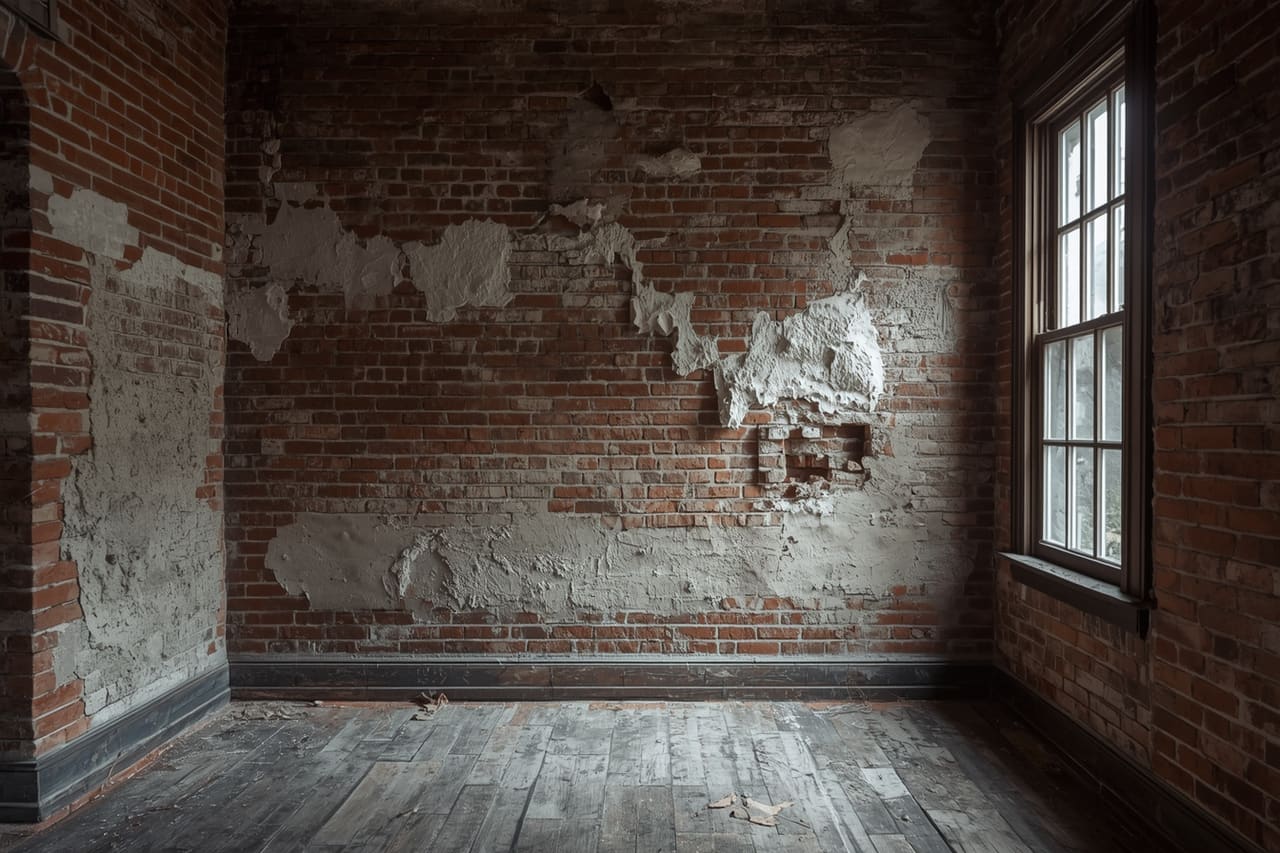
Downtown Savannah's squares are lined with brick row houses, stucco townhouses and wooden cottages, and Beaufort's historic district has its own generation of raised wooden houses with deep porches. Many were built before electricity, never mind central air. They have outlasted storms and fevers because they were designed to move water and heat around, not to keep them out entirely. Mold in these houses is often a sign that something in that old system was interrupted. The place to start is understanding how the system worked.
Old masonry breathes
Historic brick and lime-based mortar and stucco are porous. They take in water and let it out again, as long as the surface can dry. Lime mortar is softer than the brick and sacrifices itself, so repointing works over decades. Modern Portland cement mortar and hard paints and sealers do the opposite: they trap water in the brick, which then freezes and spalls in cold climates and, in a humid one, stays wet and grows mold and algae on the inside face of the wall.
If a wall is damp, the cause may be a failed gutter or downspout, a roof leak, a sealed or painted surface that can no longer breathe, or ground water. Treat the cause before touching the surface. A stain that returns after cleaning means the water is still coming from somewhere.
Rising damp and ground-floor rooms
Rising damp is water drawn up from the ground into a wall by capillary action. In a house with a raised parlor floor above a ground-level room, the lower level sits in contact with soil. Salt crystals, peeling paint, a powdery white residue and a smell of damp near the base of the wall are classic signs. Savannah's high water table and tidal influence mean groundwater is never far down.
Common mistakes include injecting chemical damp-proof courses without diagnosing the actual problem, coating the inside with waterproof paint, or applying cement render. Each can force moisture into other parts of the wall. A building conservator, a historic masonry specialist or an experienced restoration contractor can assess whether the issue is capillary, a leak or condensation. Drains and grading outside often matter as much as anything inside.
Plaster, lath and wallpaper
Plaster over wood lath, or directly on brick, is common in older homes. It holds moisture from a roof or window leak and dries slowly. If plaster is still firm, it is often drier than it looks and can be saved. If it is soft, crumbling or detached from the lath, it must be removed. Old wallpaper and layers of paint can hide stains and mold. Mold on plaster can often be cleaned, but if growth is behind the plaster, a moisture-source repair comes first.
Heart pine floors and old wood
Many old floors are heart pine, dense and hard to replace. Water makes them cup and swell, but they can often be dried slowly and saved. Fast heat can crack them. A crew should use controlled drying, monitor moisture content and be willing to give a floor time. Matching old boards after a loss is difficult, which is why preservation is worth an extra conversation. See repairs after water damage for how rebuilds deal with old materials.
Old windows, roofs and flashing
Original windows with wavy glass and wood sashes are repairable. Leaks usually come from failed putty, open joints, rotten sills or poor flashing around the frame, not from age alone. Old roofs of slate, tin or terne metal and wood shingles can outlast modern roofs when maintained, but a broken slate or an open seam sends water into the attic and down a wall. Check gutters, valleys, chimneys and around dormers after each major storm. Falling live oak limbs and pine branches damage roofs here, so a post-storm look from the ground and the attic is worth it. See storm damage restoration.
Air conditioning in a house made to breathe
Adding air conditioning is the single biggest change many old houses have seen. Cold surfaces inside the walls and in ducts meet humid air from outside and produce condensation. Tall rooms with ceiling fans and open windows once handled humidity; sealed rooms with AC do not unless humidity is managed. Keep indoor humidity in the range the EPA suggests, around 30 to 50 percent, use dehumidification where needed and avoid blocking old ventilation paths like crawl space vents and attic gables without advice from someone who understands old buildings.
Raised foundations and crawl spaces
Many historic houses have a raised basement, a crawl space or brick piers. These areas hold water readily, as covered in crawl space mold in Lowcountry homes. The same cautions apply, with one more: do not fill an old brick-walled space with modern sealing methods without checking how the walls manage moisture.
Lead paint and asbestos before pre-1978 work
Houses built before 1978 may contain lead-based paint, and older ones often have asbestos in plaster, floor tile, pipe wrap, roofing and flooring adhesives. Sanding, scraping or demolishing these materials can release dust. The EPA has rules and guidance for work on pre-1978 homes, and contractors who disturb paint in them are expected to follow lead-safe practices. If you plan removal, ask the crew how they handle lead and asbestos, and consider testing materials before demolition. This is also a reason not to scrub or sand moldy painted surfaces yourself in an old house. The EPA's lead pages are at epa.gov.
Historic districts and what to check first
Savannah and Beaufort both have historic review. Before changing visible exterior parts, such as windows, siding, roofing material, porch details or paint colors, check with the city's historic preservation office. Interior drying and removal usually do not require approval, but the exterior repair that follows might. Ask before you order materials, and keep before and after photos. Insurance adjusters and reviewers often like to see documentation of the original condition.
A sensible order of work
- Stop the water: roof, gutter, plumbing, grading or window leak.
- Photograph and document.
- Dry the structure gradually, with moisture meters guiding the schedule.
- Remove only what cannot be dried: loose plaster, soft wood, wet insulation.
- Clean mold from salvageable surfaces with methods suited to old materials.
- Repair using compatible materials: lime-based mortar, matched trim, original-style windows where review requires.
- Check humidity afterward and fix whatever allowed the problem.
For the removal step, see mold removal, and for testing and inspection questions, see mold inspection.
Choosing someone for an old house
Look for a crew that has worked on old buildings and can explain why it chooses a method. Ask for a written scope, proof of liability insurance and verifiable training credentials. Neither Georgia nor South Carolina licenses mold work today. For repair and rebuild, ask for the contractor's state license number. A good specialist will talk about preserving original material, not only replacing it.